.png)
Dr Hiranya Sudasinghe - He Chose the Fish
Updated: Sep 4

A story on curiosity, courage and the small lives that make Sri Lanka extraordinary
There was a perfectly respectable future waiting for Hiranya Sudasinghe.
He had qualified to study medicine.
In Sri Lanka, this is not ordinarily regarded as one possibility among several. It is excellent news, a family achievement and, in many households, the conclusion of the discussion.
Hiranya had one difficulty.
He did not want to become a doctor.
“When I did my A/Ls I got selected to do medicine. But I never wanted to do medicine.”
What he wanted was to do zoology.
This was harder to explain. Medicine offered a recognised profession, social approval and a future that could be described to relatives in one sentence. Zoology offered small animals, uncertain employment and rather more mud.
The response around him was not entirely encouraging.
“It was not easy because it was like, ‘Are you mad? What is wrong with you?’”
He understood the concern. Medicine was certainly the safer career. But zoology was the reason he had chosen biology in the first place.
So he chose the fish.
That decision would eventually take him from Sri Lankan streams to the genomes of some of the smallest known fishes in the world, and into a body of research helping us understand how freshwater-fish populations differ, how they are related and why some of Sri Lanka’s least visible animals matter so much.
At the time, however, it was simply a young man telling the people who loved him that their sensible plan was not his.
Before the science, there was a fish tank
Hiranya’s story did not begin with a dramatic childhood encounter in Yala.
There was no leopard emerging through the mist. No elephant placing a meaningful trunk upon his shoulder. No elderly naturalist announcing that the boy had been chosen by the forest.
He kept fish.
“I guess as a kid I always liked fish. I used to keep fish when I was really small. I think that’s probably how I started.”
He is amused by the fact that his beginnings were so ordinary.
“I wish I could say that I grew up every weekend going to Yala and seeing elephants, leopards and bears. But unfortunately that’s not me.”
The animals that held his attention were smaller and less cooperative with tourism.
They lived beneath the water, under rocks and among fallen leaves. To see them, one might need to snorkel through a stream, bend close to the forest floor or investigate a piece of leaf litter that had so far attracted no public interest whatsoever.
“My niche is more these small critters that are not the ones you usually see if you go to a national park.”
As a schoolboy, he joined the Young Zoologists’ Association. It allowed him to enter the field with people who shared his interests and to see animals in their natural habitats.
He began keeping a field diary.
The science came later.
“My interest was really to go out and be curious and see those animals in nature.”
That order matters.
Curiosity came first. Expertise was what he built so that his curiosity could ask better questions.
When an interest becomes a life
Parents are often warned not to force their children into careers they do not love.
This is easy advice to give when one is not responsible for the child’s future.
Parents know that enthusiasm can change. They know that fascinating subjects do not always lead to stable work. They worry because they love their children, and because the world is usually less generous towards unconventional choices than graduation speeches suggest.
But there is another risk.
A child may become highly successful at something that never felt like their life.
Hiranya saw capable students enter professions largely because those professions were expected of them.
“I know a lot of people who are really bright students, who are really good at what they do, but because of social pressure they get stuck in following a different profession.”
His own choice did not succeed merely because he was passionate.
Passion had to become work.
He studied zoology at the University of Peradeniya, graduated with first-class honours and later completed his PhD at the University of Bern in Switzerland. His research has helped clarify species identities, reveal previously unrecognised diversity and examine how freshwater-fish populations in different rivers are related.
The child who liked fish had not simply followed a dream.
He had spent years becoming qualified to follow the evidence.
“Then I chose to do zoology, and I think this changed my life because what I’ve done so far is because of that decision.”
For parents, the lesson is not that every childhood interest should immediately become a career plan.
It is that sustained curiosity deserves to be examined before it is dismissed.
A child who likes something for a week may have found a hobby. A child who returns to the same questions for years may be showing the beginning of a vocation.
The task is not simply to protect the passion.
It is to help a child discover whether they are prepared to do the work that passion requires.
Hiranya was.
And the deeper he looked, the more he found that some of Sri Lanka’s most extraordinary stories were being carried by its least noticeable animals.
The animals that built a biodiversity hotspot
Sri Lanka’s wildlife celebrities are difficult to avoid.
The elephant has scale. The leopard has mystery. The whale has the considerable advantage of being the largest animal that has ever lived.
A tiny freshwater fish has none of these promotional benefits.
Yet Hiranya argues that much of what makes Sri Lanka biologically exceptional is found among the animals that attract the least attention.
“We talk about Sri Lanka as a biodiversity hotspot and all sorts of stories, but you don’t understand that this is mostly because of these really unknown animals that are the endemics.”
An endemic animal is naturally found nowhere else.
Its entire global home may be Sri Lanka, one part of Sri Lanka or, in some cases, a remarkably small stretch of water.
This means that a fish capable of disappearing beneath a leaf may be more uniquely Sri Lankan than an animal found across much of Asia.
And still, Hiranya says, our knowledge may stop at its name.
“You know a name, you know it’s endemic, but what else do you know?”
Where does it breed?
What kind of water does it require?
Are populations in different rivers connected?
Has one species been mistaken for several, or several for one?
Why is it disappearing?
A species cannot be protected intelligently merely because someone has added the word endemic beneath its photograph.
First, it must be understood.
Learning to read an island through its fish
Hiranya’s work looks for the histories hidden inside freshwater fishes.
Their shape offers clues. Their distribution offers clues. Their DNA offers another kind of record.
Two streams may look identical to us, yet the fish in them may have remained separate for generations and carry different inherited characteristics.
Hiranya compares fishes from different rivers, examines their physical features and studies their DNA to understand which populations are related, which have remained separate and why those differences matter for conservation.
The scientific terms include taxonomy, systematics, population genetics, genomics, phylogenetics and biogeography.
Behind them lies one simple question:
What is living in these streams, how is it connected and what could be lost if we fail to recognise the difference?
Each study revealed one part of the picture.
The project Hiranya is proudest of was the one that allowed him to step back and see how those parts belonged together.
The book he is proudest of
When Hiranya is asked which of his projects he feels proudest of, he does not choose a newly described species, an advanced genetic study or even his doctoral research.
He chooses a book.
In 2021, he and Rohan Pethiyagoda published The Ecology and Biogeography of Sri Lanka: A Context for Freshwater Fishes.
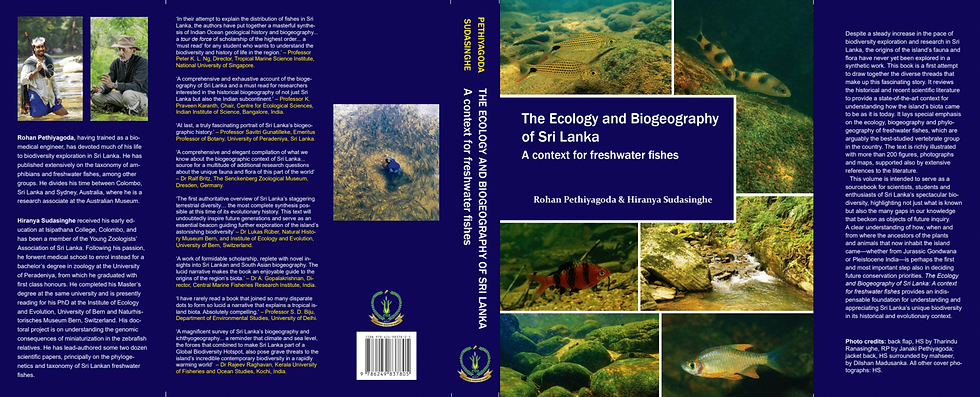
Hiranya describes it as a synthesis: a place where findings and ideas scattered across different scientific papers could finally be considered together.
“It was more like a synthesis where we could put together all those results and all those ideas into one place.”
Scientific papers are designed to answer particular questions. One may examine the identity of a fish. Another may compare populations. Another may investigate why related species occur in different parts of the island.
The book steps back and asks what all those individual findings reveal when placed beside one another.
How did Sri Lanka come to contain this particular collection of life?
Why are some species found in one region but not another?
What can freshwater fishes tell us about the island’s geography, climate and biological history?
Hiranya co-authored the book with Rohan Pethiyagoda, one of Sri Lanka’s most influential modern researchers on freshwater fishes and the recipient of the Linnean Medal for Zoology in 2022, an award recognising sustained contributions to the understanding of the natural world.
That gives useful context to the collaboration.
But the real significance lies in what the two researchers assembled.
The book gathers years of separate findings into a larger account of Sri Lanka’s biodiversity, biogeography and freshwater life. Hiranya believes it can provide a valuable starting point for anyone who wants to understand more than the name of a species or the fact that it is endemic.
And then, with the understandable affection of an author recommending his own book, he adds,
“Maybe I’m biased.”
He probably is.
Authors generally are.
But his recommendation is also a useful one.
A field guide can tell us the name of the fish in front of us.
This book attempts to explain what that fish, where it lives and how it differs from fishes elsewhere can tell us about Sri Lanka itself.
The book enabled Hiranya to step back and consider the larger picture.
His doctoral research took him in the opposite direction: towards a fish so small that an adult could rest comfortably on a fingernail.
A fish smaller than a fingernail
For his PhD at the University of Bern in Switzerland and the Natural History Museum of Bern, Switzerland, Hiranya studied miniature freshwater fishes, including members of the genus Paedocypris.
Some mature individuals measure less than eight millimetres in length, placing them among the smallest known fishes in the world.
Hiranya puts the scale more simply:
“There are really small fish, like an adult fish that is 7mm standard length.”
His research examined the genetic and developmental features associated with becoming so extraordinarily small.
“I was interested in understanding the genomic background: what’s in the genome that potentially explains the fish becoming miniaturised.”
A fish smaller than a fingernail can still present a scientific problem large enough for a doctorate.
His current postdoctoral work continues to use genetics, but with a more directly conservation-focused purpose. He is analysing several groups of Swiss freshwater fishes to understand how their populations are structured and related, as part of a larger evidence-based national conservation project.
The work is separate from his research on Sri Lankan fishes, but the underlying question is similar:
What can the differences hidden within a species tell us about how it should be understood and protected?
That willingness to look for significance where others may see very little runs through more than Hiranya’s research.
It runs through the choices that shaped his life.
The value of choosing what others overlook
Hiranya’s life and work share an interesting pattern.
He chose a subject that others considered less secure, then built a career around animals that society often considers less important.
A small fish did not need to be spectacular to deserve his attention.
Zoology did not need to be the safest career to be the right one for him.
Neither decision was sustained by enthusiasm alone. Curiosity had to become discipline, training and years of careful work.
That may be the most useful lesson in his story.
For a young person, courage is not merely choosing the thing you love. It is becoming serious enough to serve it well.
For a parent, support need not mean promising that every interest will become a career. It may simply mean giving sustained curiosity enough room to prove what it can become.
And for those of us who chose differently, Hiranya’s work offers another invitation: not necessarily to abandon the lives we have built, but to ask what our existing skills might still contribute to the living world.
Hiranya chose the fish.
Because he did, the rest of us can understand a little more clearly what has been living beneath the surface all along.
Continue beneath the surface
Hiranya’s interview leaves us with questions far too interesting to hide inside one profile.
Explore What Dr Hiranya Sees Beneath the Surface, where each question becomes one short journey into the freshwater world most of us have never learned to notice.
Story 1 of 10: What happens when conservation gets a fish’s name wrong?
Story 4 of 10: Could tidying a stream be the worst thing you do to it?
Story 5 of 10: Can saving one aquarium fish harm thousands of wild animals?
Start your journey beneath the surface
When taxonomy gets a name wrong, even the best conservation efforts can end up protecting the wrong thing.
Read Story 1: What happens when conservation gets a fish’s name wrong?


Comments