.png)
Jonklaas’s Loach and the Curse of the Tidy Stream
Updated: Sep 3
Imagine checking into a plush hotel room that looks pristine.
The bed is tightly tucked, the surfaces are scrubbed bare and everything is perfectly in place. From the doorway, nothing appears wrong.
Only after a step inside do you notice what is missing. The air is entirely still. It is thick, heavy and stripped of the invisible currents that allow you to breathe comfortably. The room still has its shape, but it has lost its ventilation, and with it, its capacity to hold life. You come to realise it is a space designed to be looked at, not lived in.
Some streams can feel like that, which is an unsettling thing for water to pull off.
You stand beside one in Sri Lanka’s wet southwestern lowlands and everything looks reassuring at first. Water moves over stones. Shade falls across the channel. Leaves gather at the edges. It sounds like a stream should sound. It looks, to a passing human, entirely alive.
But a stream can keep its familiar appearance while its invisible makeup shifts. Just like that suffocating room, the water can look perfectly clear while becoming less able to support the species that belong there.
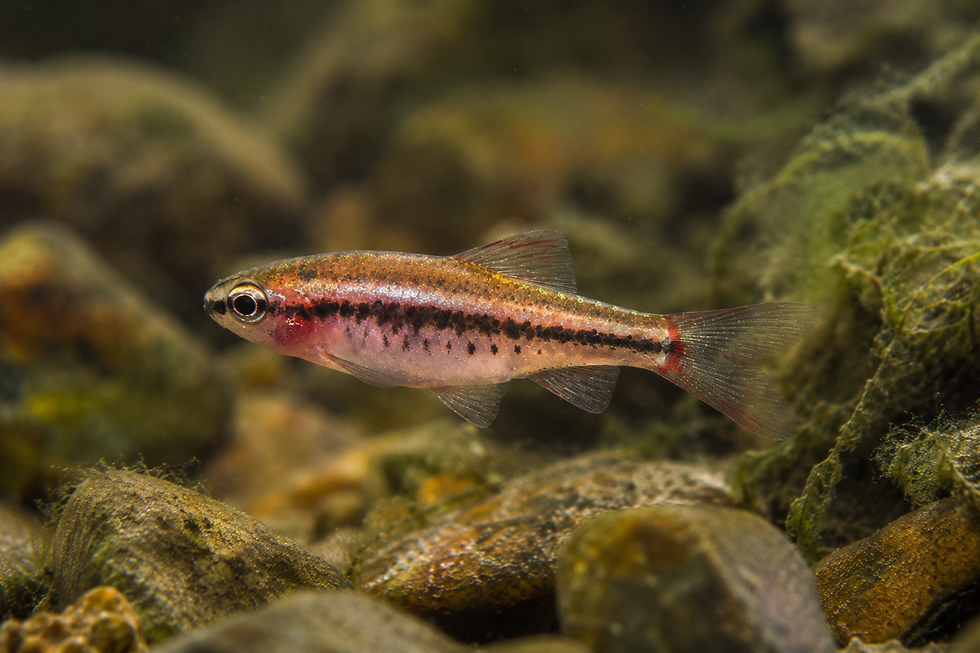
That quiet distinction matters for a small freshwater fish with a name that sounds like it should be printed on a very niche Swiss watch: Jonklaas’s Loach or Lepidocephalichthys jonklaasi.
If you currently feel like you’ve accidentally opened a Gothic horror novel instead of an article with our usual panache, hang in there because I promise the doom and gloom ends right here. Especially because a creature with a name that aristocratic deserves better than a sad backstory.
Being called jonklaasi, you’d expect this fish to demand a glass of sparkling water and a tiny velvet pillow. Instead, Jonklaas’s Loach reacts to its changing neighbourhood the way any reasonable bottom-dweller would: by aggressively burrowing face-first into the mud, leaving only its tiny, judgemental eyes sticking out to glare at passing shrimp. It’s hard to save the world when you look like an angry noodle, but this fish is trying its best.

Why This Matters
Jonklaas’s Loach is a small freshwater fish associated with shaded streams in Sri Lanka, the kind of place where leaf litter, roots and a bit of underwater clutter are not untidiness but furniture.
It is not among the animals that usually anchor global conservation campaigns, which is precisely why it deserves a little borrowed attention from the rest of us.
It is listed as a protected fish under Sri Lanka law. It is also listed as Endangered in the IUCN Red List of Threatened Species, as of 2019. Its conservation status matters because it seems to live in a fairly small area and to depend on a fairly particular kind of stream. In practical terms, that means it may have less flexibility than more widespread species when stream conditions change.
The larger ecological point is straightforward. A stream is not simply water moving through a channel. For species that live there, habitat includes shade, slow-flowing water, leaf litter, things in the water that create cover such as roots and branches, bank condition, water quality and the many small interactions between them.
We might laugh at ourselves for shrinking away from squishy, yucky mud or stepping carefully around prickly sunken branches, but it is wonderful to realise that this exact texture is what an endangered species needs to thrive. We can carry that thought with us as a friendly reminder the next time we feel that sudden tickle underfoot while wading. Remove enough of those elements and the stream may still be visible, but less livable.
For many lesser-known freshwater species, detailed long-term monitoring is more limited than for famous mammals or birds. That does not make concern less valid. It simply means careful language matters. In conservation, uncertainty is often part of the landscape rather than a reason to ignore it.
The Challenge
The difficulty is not usually one dramatic event. More often, it is a stack of ordinary changes moving through the same system.
A small stream sits inside a shared workspace, whether the neighbours asked for that arrangement or not. Someone upstream clears a bank, someone else washes something into a drain and the stream ends up keeping the minutes.
Forest cover, gardens, roads, drains, farms, settlement patterns, local maintenance habits and land-use decisions upstream all leave traces there. Water carries the record.
A little less shade can change temperature and shelter. A tidied bank can remove roots and cover. Runoff can bring detergents, oils, sewage or agrochemicals. Channel straightening can simplify flow and reduce the messy structure many freshwater species depend on.
None of these pressures needs a villain to exist. They often emerge from understandable human habits: cleaning, building, draining, improving access, reducing flood anxiety or making land look managed. The challenge is that a stream does not read neatness the way people do. Human beings can look at a trimmed bank and feel the deep municipal satisfaction of having improved something.
Unfortunately, a stream is rarely improved by being made to resemble the edge of a competent car park.
To many human eyes, a good stream can look slightly untidy. This is awkward for anyone who has ever mistaken habitat for poor housekeeping. To a fish, that untidiness may be infrastructure. There is something quietly marvelous in that: a world where a curled leaf and a shaded root can mean the difference between passing through and belonging.

Who’s Doing Something About It
Before people can protect a species well, they need to be sure they are identifying the right populations.
In 2023, eight researchers published a genetic study on the loach genus Lepidocephalichthys. While covering several species across Sri Lanka and India, its findings are foundational for Jonklaas’s Loach. By mapping DNA, the study clarified which populations are unique to specific streams. This ensures conservation resources reach the correct habitats rather than being spread thin over common lookalikes.
The People Already Helping
This study was forged through a collaboration of local and international scientists, including Hiranya Sudasinghe, Kumudu Wijesooriya, Neelesh Dahanukar, Rajeev Raghavan, Tharindu Ranasinghe, Rohan Pethiyagoda, Lukas Rüber and Madhava Meegaskumbura. They did not just publish data. They helped sort out which populations were which, which is less glamorous than saving a tiger on a poster but is often how real conservation starts.
By laying out a clear genetic blueprint, such studies provide conservationists and policymakers with a powerful toolkit. Foundational science like this helps experts defend critical habitats with clearer evidence and more targeted preservation efforts.
This is not about individual accolades. It is about the verifiable architecture of conservation. It is the steady process of identifying specimens, mapping genes and documenting findings so the science remains usable.
The Systems That Quiet Work Runs Through
Think of these as the unglamorous cogs keeping a small fish from being accidentally erased.
No one prints posters about an assessment update pipeline, but without them, Jonklaas’s Loach is just a very small, very lost resident of the leaf litter.
The Department of Wildlife Conservation (DWC) is part of the legal machinery that can make protection real, by enforcing rules and managing protected areas. The legal protection system provides a basis for restricting collection and supporting enforcement, although legal protection alone does not guarantee habitat protection on the ground.
Assessment systems such as national and global Red Lists help make conservation risk legible. Without those assessments and records, decline stays easier to overlook and harder to address in any useful way. Without this entry, the loach remains an obscure fish instead of a conservation priority.
However, there is a stubborn reality in Sri Lanka: rare fish don’t always live in national parks. Sometimes they can be found in streams adjacent to rainforest habitats where there is some human activity. To keep those waters safe, the main legal protection comes from the Fauna and Flora Protection Ordinance (FFPO), administered by the DWC. Public awareness is raised by multiple environmental conservation NGOs such as the Wildlife and Nature Protection Society of Sri Lanka (WNPS). Finally, local universities and museums maintain the records that prevent monitoring from becoming guesswork. Scientific paperwork is often the only thing standing between a species being protected or being lost.
What You Can Do
You do not need to become a freshwater specialist to be useful here. It is enough to start with actions that fit ordinary life.
Easy
Treat small streams as living habitat, not empty drainage space. Do not dump waste, detergents, oils or garden chemicals into water connected to natural streams.
Practical
If you live, work or study near a stream, avoid clearing plants growing along the stream edge or disturbing shaded banks without good reason. Small changes in shade, runoff and bank condition can alter habitat even when a stream still looks normal.
If a school, neighbourhood or local group is doing stream clean-up or care work, push for the careful version: remove rubbish, but do not ‘tidy’ away leaf litter, woody debris or stream-edge cover that freshwater species may depend on.
Deep
If your work touches land use, water, farming, landscaping, development or education, ask whether a project will affect small streams by sending more dirty water into them, warming them up, damaging their banks or disrupting their natural shapes. That is a more useful question than assuming a stream is fine because water is still flowing.
If you support conservation work, back a vetted local effort that protects freshwater habitat, water quality or catchment condition. For this species, protecting the stream itself is usually a safer focus than direct handling or relocation.
None of these actions needs to be dramatic to matter. That is good news, because most real care arrives wearing ordinary clothes.
Your One Move
If you remember just one thing, let it be this:
The next time you see someone treating a small stream like it should be tidied into neatness, gently suggest that messy can be healthy. You can share this article and simply say, 'I never realised that a messy stream is actually a healthy one.'
It is a low-friction action. It is biologically meaningful. And in many places, it is more realistic than expecting people to carry out formal conservation work themselves.
Why This Matters, and When You Might Use It
You may not find yourself in this situation often. That is normal.
But when the moment does appear, at a garden edge, near a drainage line, beside a footpath, in a school project or during local maintenance, one calm comment can interrupt a common misunderstanding. The misunderstanding is simple: if water is present and the scene looks orderly, habitat must be fine.
Correcting that idea can have practical effects. It can help protect shade, leaf litter, woody debris and bank structure. It can also spread a more accurate social picture of what a living stream looks like.
Sometimes stewardship is not about doing more. It is about removing one bad assumption from circulation.
How To Do This Simply
You do not need a speech. A sentence or two is enough.
You could say:
‘It actually helps some endangered stream species if the banks stay a bit natural.’
‘Some of that leaf litter and wood is part of the habitat.’
‘A stream can look cleaner after tidying, but not always healthier.’
‘It might be worth checking before removing that. Small fish and invertebrates can use it.’
These phrases work because they are calm, respectful and easy to say without turning the moment into a confrontation.
Final Thought
A healthy stream is still a place that keeps room for others.
From the outside, it can seem effortless. What makes it work is not polish alone. It is the presence of small, often invisible forms of support: shade, structure, cover, things left undisturbed at the right moment.
Jonklaas’s Loach depends on that kind of quiet support. So do many other freshwater species people rarely notice.
The stream does not need to look impressive to be important. A great many essential things in nature have the bad luck to look ordinary from a distance, but they carry the extraordinary potential to sustain life.
It only needs to remain livable, and by protecting its wild clutter, we give these vital spaces their best chance to thrive.
For Advocates:
If you already care about rivers, wetlands and wildlife, you might share this idea with someone who still equates neatness with ecological health.
For New Readers:
If you are newer to this kind of story, you are welcome here too. You do not need specialist language to begin noticing freshwater life more carefully. Attention is a valid starting point.
Join us to become an Advocate – Learn, Share, Act.
What We Still Need to Know
There is still plenty worth learning about species like Jonklaas’s Loach and the systems around it.
Science: How do seasonal changes, water quality shifts and habitat fragmentation affect populations over time?
Policy: How well do legal protections translate into protection on the ground?
Education: What helps people most quickly understand that ‘messy’ can be ecologically functional?
Technology: Can lower-cost monitoring tools improve freshwater data for lesser-known species?
Ethics: How should conservation prioritise quiet endemic species that attract little public attention but may carry high ecological value?
For now, one lesson is already clear enough to carry forward:
A stream can keep its shape long after some of its welcome has thinned out.
A stream can look fine and still stop being a home.


Comments